(Le Havre, 1877 - Forcalquier, 1953)
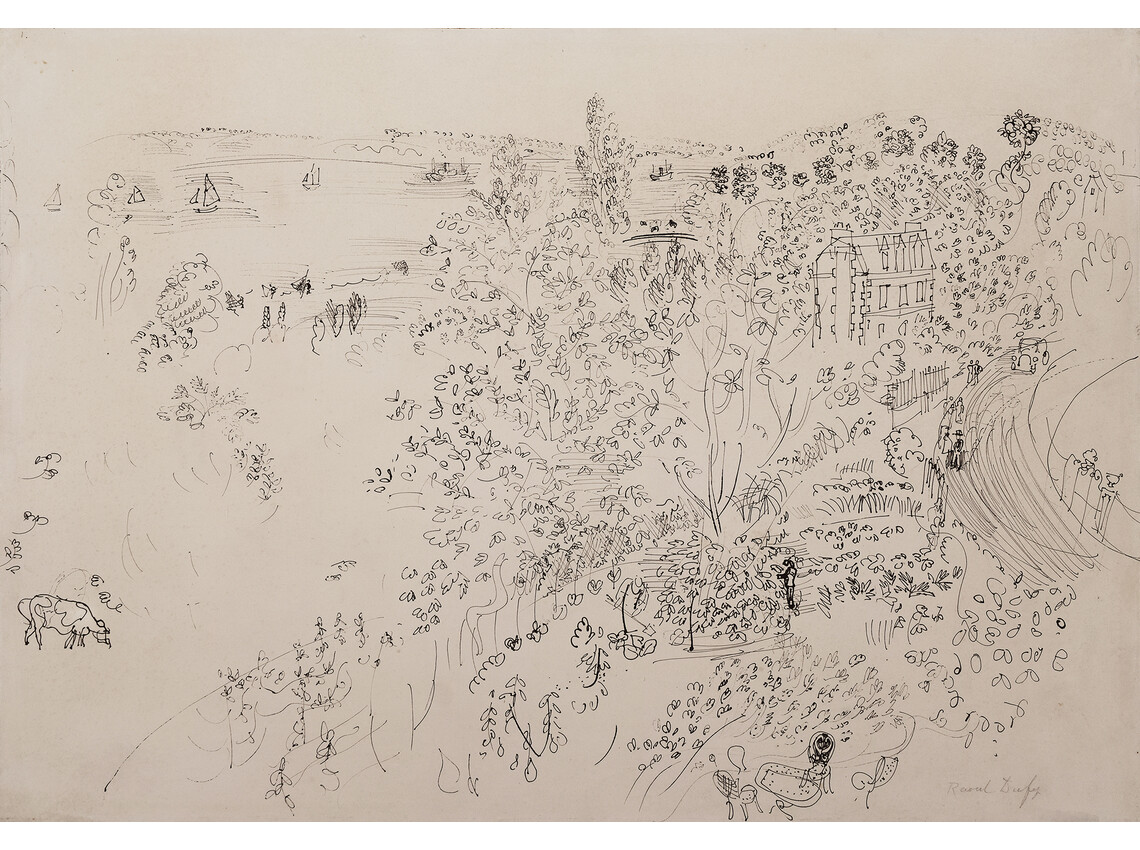
Villerville, 1928
Pen and Indian ink drawing on Arches paper
Signed lower right Raoul Dufy
45.7 x 62.5 cm
Provenance :
Private collection, France
Literature :
Raoul Dufy, Catalogue raisonné des dessins, volume I, by Fanny Guillon-Laffaille, published by Galerie Fanny Guillon-Laffaille and Marval, Paris, 1991, described (with dimensions 50 x 60 cm) and reproduced on p. 125, no. 291
is a French commune, a former fishing village, located in the Calvados department in the Normandy region.
The seaside villages of Villerville, Trouville and Honfleur became popular destinations in the 19th century for wealthy Parisians seeking to escape the hustle and bustle of city life.
In 1880, the Impressionist painter Gustave Caillebotte painted Vue de mer, Villerville (Seascape, Villerville). The greenery is rendered with meticulous detail and careful observation, and thanks to the balance of saturated colours in the foreground with the lighter pastels in the background, the composition is harmonious and centred on a red villa by the sea.
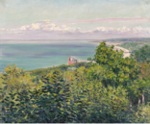
Gustave CAILLEBOTTE, Vue de Mer, Villerville, 1880, oil on canvas
The seaside resort of Villerville, located on the other side of the Seine estuary, opposite Le Havre, the birthplace of Raoul Dufy, inspired the artist, who in 1928 painted a series of oil paintings on canvas for which our drawing in Indian ink, produced in the same year, is preparatory.
In each of these oil variants, the artist chose the same elevated viewpoint, depicting a panoramic landscape suggesting rolling hills and varied vegetation, with the sea depicted in the background to the left of the composition.
The landscape is teeming with charming details that bring it to life, such as the winding road with the occasional passer-by. A typical Norman-style bourgeois house in red brick stands isolated in the countryside. Sometimes, on the left of the composition, as in our drawing, a Norman cow grazes peacefully in a meadow. Several boats in the distance are also visible in the paintings and in our drawing. In the latter, a car is shown driving along the road and two figures are busy in the garden. In some cases, several garden chairs and a table can be seen in the foreground, as in our drawing.

Raoul DUFY, Villeverville, 1928, oil on canvas
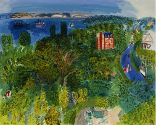
Raoul DUFY, Villeverville, 1928, oil on canvas
A panoramic view of a coastal village comes to life, with lush greenery and a distant blue sea with sailboats on the horizon. In the foreground, a cluster of brightly coloured trees and plants frame the scene, drawing the viewer's eye to a striking red house on the right. The winding path and gently curving road create a fluid movement throughout the composition, evoking a sense of tranquillity and harmony. The work is characterised by playful, almost childlike brushstrokes typical of the naïve art style, which add a whimsical and endearing quality to the landscape.
In addition to Gustave Caillebotte and Raoul Dufy, Villerville also served as a subject for Eugène Boudin, Edouard Vuillard and Lucien Coutaud.
It is interesting to note that the viewpoint adopted by Dufy in our Indian ink drawing and the paintings based on it is similar to that of Caillebotte in his 1880 painting, Vue de Mer, Villerville, with the same large villa by the sea.
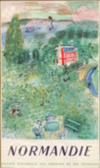
Raoul Dufy also produced several watercolours on the same subject in 1928, one of which was used on a poster illustrating Normandy for Société Nationale des Chemins de Fer Français.
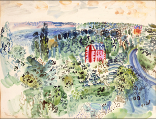
Raoul DUFY, Villeverville, 1928, watercolor on paper