
(Bordeaux, 1885 – Paris, 1962)
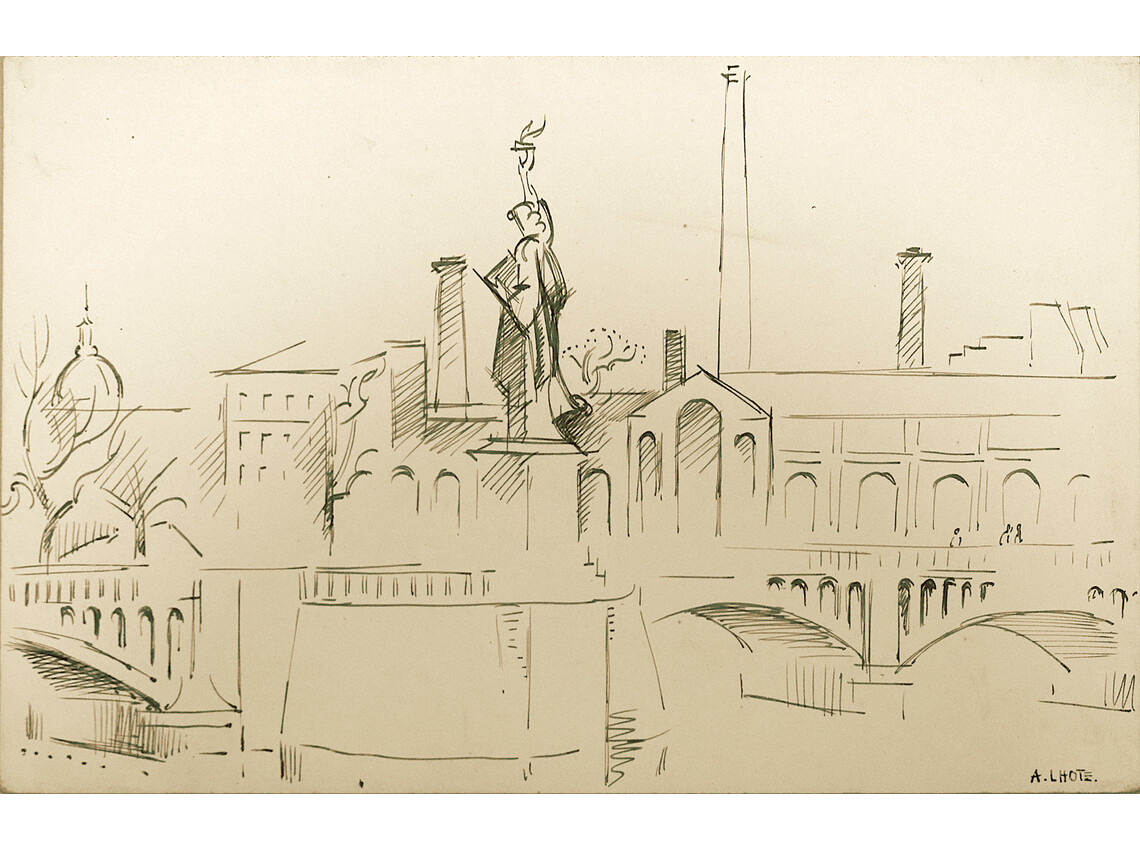
Paris, le Pont de Grenelle et la Statue de la Liberté, Circa 1933
Pen and ink on paper
Signed lower right A. LHOTE
16.9 x 26.3 cm
Provenance :
- Artist's estate, Paris
- Private collection, France
Certificate of authenticity by Dominique Bermann-Martin, Paris 1 December 205
In Paris, the Grenelle Bridge is located downstream from the Rouelle Bridge and upstream from the Mirabeau Bridge. It crosses the Île aux Cygnes, as do the Rouelle Bridge and the Bir-Hakeim Bridge.
Since its inception, three successive bridges have been built.
The first Grenelle Bridge was built between 1825 and 1827. It was made of wood and its six arches rested on masonry piers on stilts. Due to structural problems, the bridge collapsed completely and was replaced in 1874 by a second cast iron bridge designed by engineers Vaudrey and Pesson, resting on the same piers.
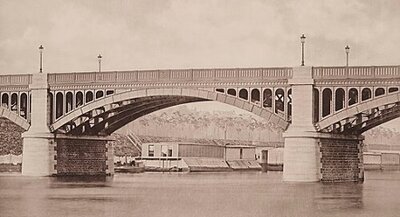
The Grenelle Bridge in 1883
The 9-meter-high bronze statue “Liberty Enlightening the World,” located at the tip of Swan Island downstream from the bridge, is the work of Auguste Bartholdi (1834-1904). It was inaugurated in 1889 by President Sadi Carnot on the anniversary of the United States' Independence.
Bartholdi protested about the orientation of the statue because it faced Paris and not the sea and the United States. It was not until the 1937 International Exhibition of Arts and Technology that the statue was finally turned around.
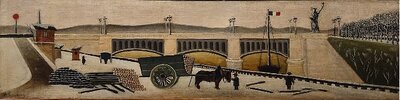
Henri ROUSSSEAU, Le Pont de Grenelle, 1892 - Collection Musée d'Art Naïf et d'Arts Singuliers (MANAS), Laval
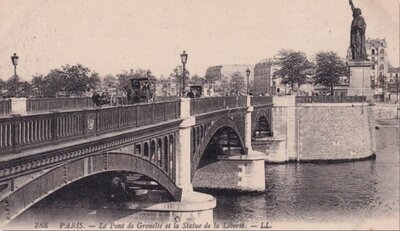
Old postcard depicting the second Grenelle Bridge and the Statue of Liberty facing Paris
The current Grenelle-Cadets-de-Saumur Bridge was built between 1966 and 1968 by engineers Jean Thénault, Grattesat, and Pilon, and architects Chauvel, Creuzot, and Jabouille. It has two 85-meter spans and a 20-meter span in the middle on Île aux Cygnes.