
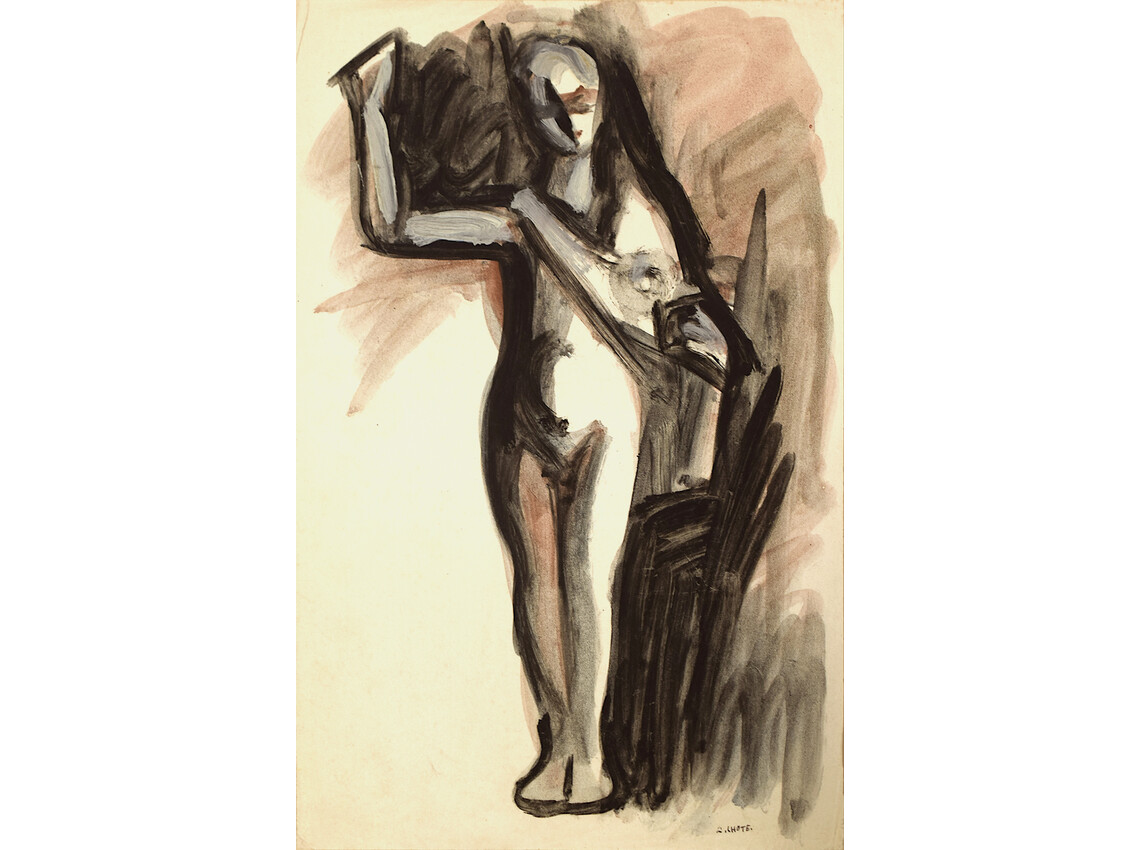
(Bordeaux, 1885 – Paris, 1962)
Nu debout, Circa 1908-1909
Gouache and peinture à l'essence on paper
Signed lower right A. LHOTE.
31.2 x 20 cm
Provenance :
- Estate of the artist
- Private collection, France
Literature :
To be included in the Catalogue raisonné de l’œuvre peint d’André Lhote in preparation by Mrs. Dominique Bermann-Martin
Certificate of authenticity by Dominique Bermann-Martin, Paris, 9 December 2025
In 1907, André Lhote exhibited for the first time at the Salon d'Automne.
He traveled to Paris for the occasion and spent long hours at the Musée du Louvre, particularly in the rooms devoted to antiquities.
The Standing Nude, painted around 1908-1909, was probably inspired by the terracotta statuettes representing Aphrodite-Venus, goddess of love and beauty, which Lhote had admired at the Louvre.
The hieratic and frontal attitude of the lower body evokes a goddess such as Aphrodite-Isis, while the nudity and the position of the arms echo the ancient representation of Aphrodite Anadyomene, meaning “she who rises from the water.”
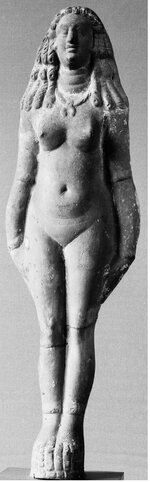
Aphrodite-Isis - Clay, Musée du Louvre, Paris, 1-100 AD (Roman Imperial period)
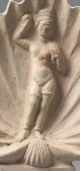
Aphrodite Anadyomene in a Shell (detail), late 1st century BC – early 1st century AD.
Clay, Musée du Louvre, Paris
In 1909, André Lhote met Georges Rouault, with whom he maintained a long correspondence. Later, Lhote wrote an article entitled George Rouault in the magazine L’Amour de l’Art (No. 12, December 1923).
Rouault advised Lhote to use paper rather than canvas for his works. Lhote followed this recommendation and praised paper in his Traité du paysage (Éd. Grasset, Paris, 1958): “When glued to canvas or panel with casein, paper provides an excellent medium...”
Lhote's Nu debout can be compared to Rouault's figures in terms of the marked outline and expressive stylization of the body.
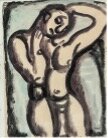
Georges ROUAULT, Acrobate, C.1913, watercolor on paper, Musée d'Art Moderne de Paris