
(Münchenbuchsee, 1879- Bern, 1940)
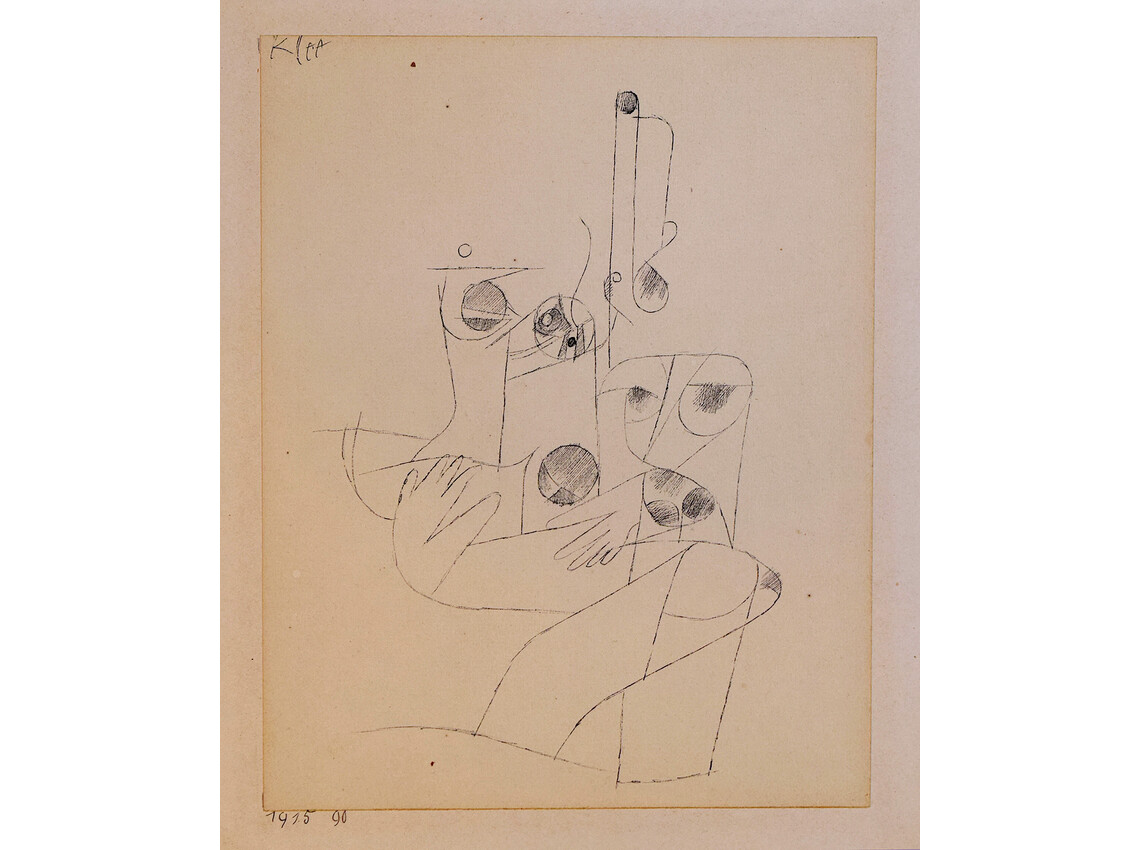
Empfindung Beim Spiel Einer Lyristin, 1915
Indian ink on Ingres paper mounted on cardboard
Signed upper left Klee
Dated and numbered lower left in the margin on the cardboard 1915 90
Dimensions of the subject: 19.3 x 15.2 cm
Provenance :
- Berggruen & Cie, Paris
- Mira Jacob Collection, Galerie Le Bateau-Lavoir, Paris
- Stéphane Petit Estate, Paris
- Private collection, Paris
Exhibitions :
- Paul Klee, Nationalgalerie, Kronprinzenpalais, Berlin, February 1923 (Klee's first museum exhibition in Germany)
- La Peinture et son double: écrits de peintres, Galerie Le Bateau Lavoir, Paris, 1974, catalogue reproduction no. 55
- Rendre visible, Paul Klee, Hans Reichel, Julien Discrit, Anne-Charlotte Finel, Musée de Lodève, Lodève, April 19 to August 31, 2025
Literature :
- Paul Klee by Will Grohmann, Geneva/Stuttgart, 1954, p. 143
- Paul Klee, by Will Grohmann, Dumont éd., 1966, p. 72
- Paul Klee, Catalogue Raisonné, band 2 1913-1918, published by the Paul Klee Foundation, Kunstmuseum Bern, Benteli Verlags AG, Bern, 2000, described and reproduced p. 271, no. 1423
- Klee. Reichel. Discrit. Finel. Rendre Visible. Musée de Lodève in Connaissance des Arts, special edition, no. 1117, 1st quarter 2025, ECL, Paris, described and reproduced in color on p. 13
“Art does not reproduce the visible. It makes visible.” It is with this famous quote that Paul KLEE begins one of the chapters of his book The Theory of Modern Art (1920-1921). According to the artist, the role of art is not to imitate or reproduce reality but to reveal it...
Our work, created in 1915, reflects the period when Paul KLEE was developing his own pictorial language, combining abstraction and figuration, poetry and geometry, while remaining distant from realistic detail.
The title “EMPFINDUNG BEIM SPIEL EINER LYRISTIN,” which can be translated as “Sensation when playing a lyrical piece” or “Sensation when playing a poetess,” brings a deeply sensory and emotional dimension to the work. It also contains an ambiguity of meaning that reinforces that of the drawing, as it can be interpreted as a musician playing an instrument or a man embracing a woman. Thus, the title and the drawing work together to create a reading that is both musical (the lyre, the musician, the instrumental performance) and poetic or emotional (the feeling, the human relationship, the amorous encounter).
The composition of fluid, sinuous lines and the superimposition of intersecting abstract forms evoke stylized human figures that seem to merge and move in unison, reflecting the subtle oscillations of the music being played. The presence of elements evoking a lyre, or at least shapes reminiscent of strings or instruments, could also reinforce this idea.
Through its sober and delicate aesthetic, this ink drawing illustrates Paul KLEE's attempt to give form and visibility to the emotions aroused by the act of playing a piece of music. The drawing thus becomes a kind of visual score, where lines and shapes play the role of notes and rhythms, immersing the viewer in the “sensation” unique to lyrical performance.
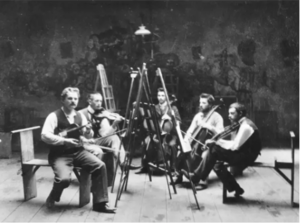
Quintet with Paul KLEE on violin (right) at the Heinrich Knirr Art School in Munich, 1900.
Paul KLEE had a passion for music. Having become a highly accomplished soloist, he played works by Bach and Mozart in concerts with the Bern Orchestra. Also displaying an early talent for drawing, he eventually began studying at the Academy of Fine Arts without renouncing his first love: “My beloved is and always has been music; if I embrace the goddess of the brush that perfumes the oil, it is because she is my wife.”